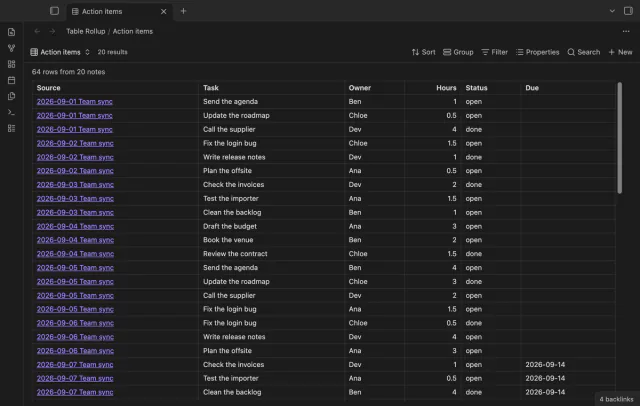
Table Rollup
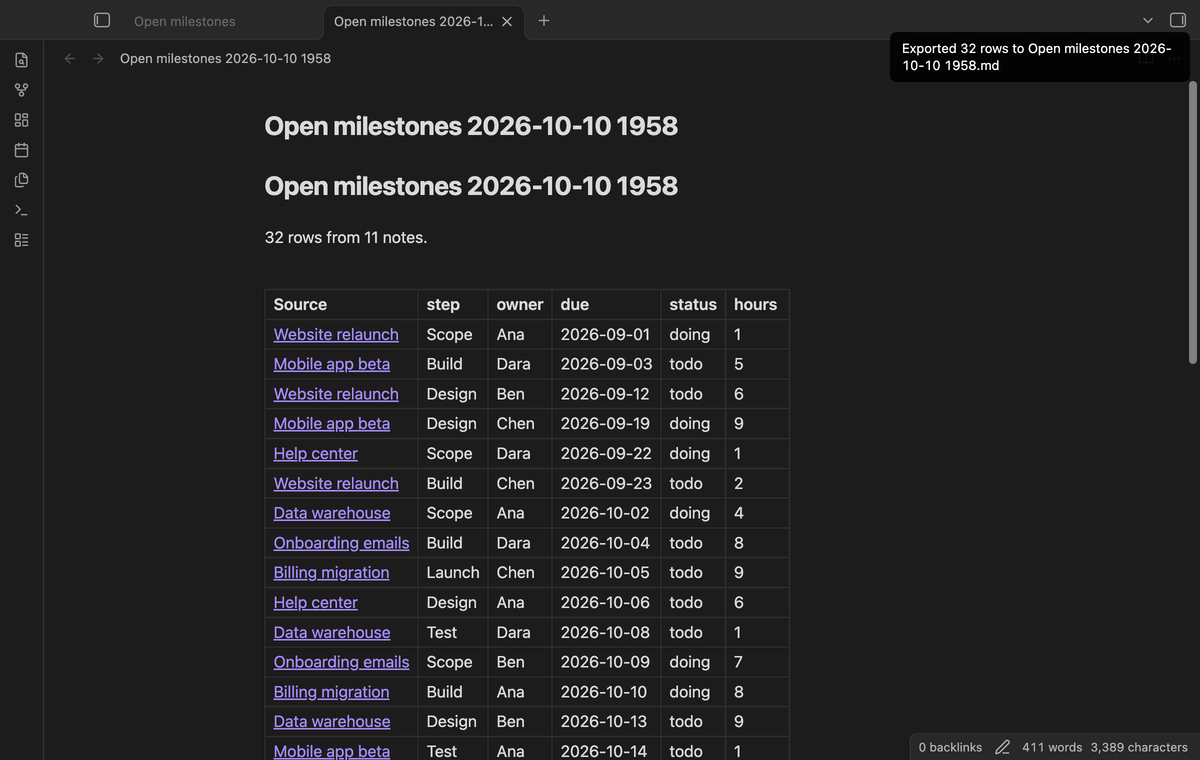
All the rows from the small tables in your notes, in one sortable table that links back to each note.
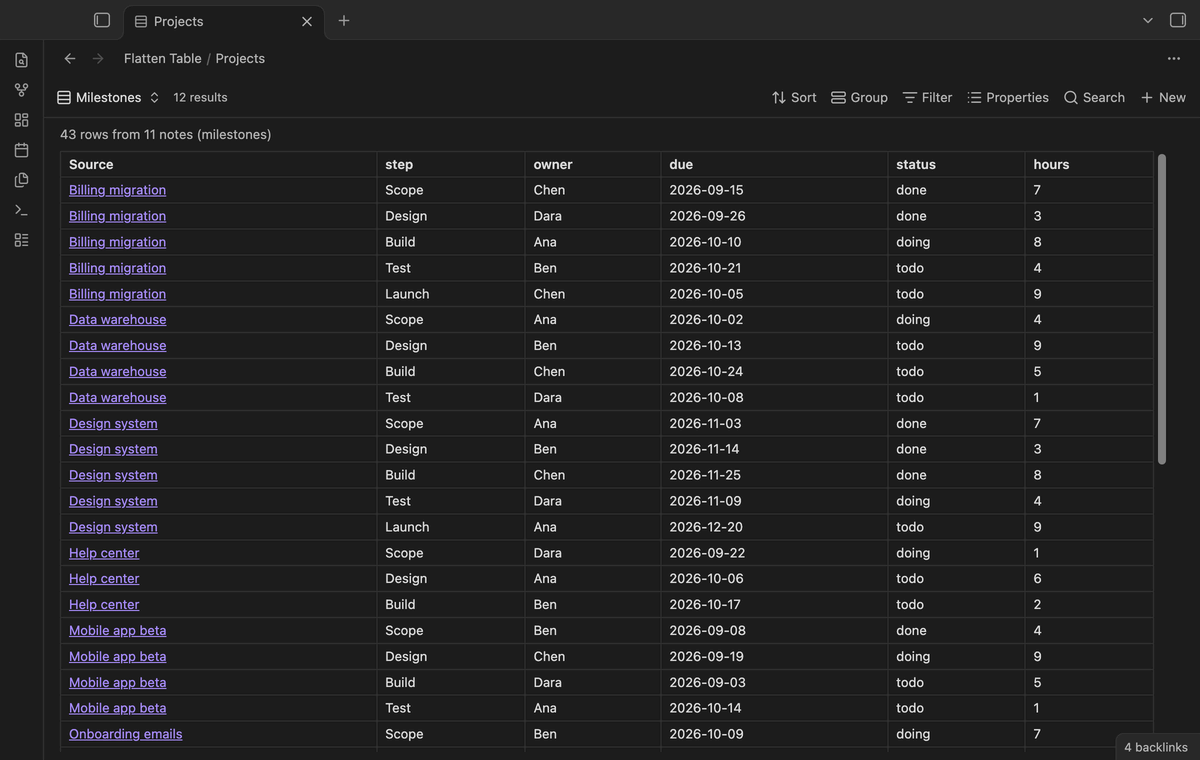
Each item of a list property becomes its own table row in Bases, so one note can give many rows.
MIT · no telemetry · core features free
Directory facts fetched from community.obsidian.md/users/theluckystrike.
People who keep a list of objects in the properties of a note, such as the milestones of a project.

The core table view of Bases gives one row per note, so a whole list is one cell. Flatten Table gives each item its own row, and the keys of the items become the columns. Your data stays in the properties of your notes.
It's a view for the core Bases plugin. The base selects the notes, and you write no query. It does the same job as the FLATTEN command of Dataview.
 Play demo
Pick a list property in the view options. Each item of that list becomes one row, with a Source column that links to its note. When the items are objects, each key is a column, and keys match without regard to case.
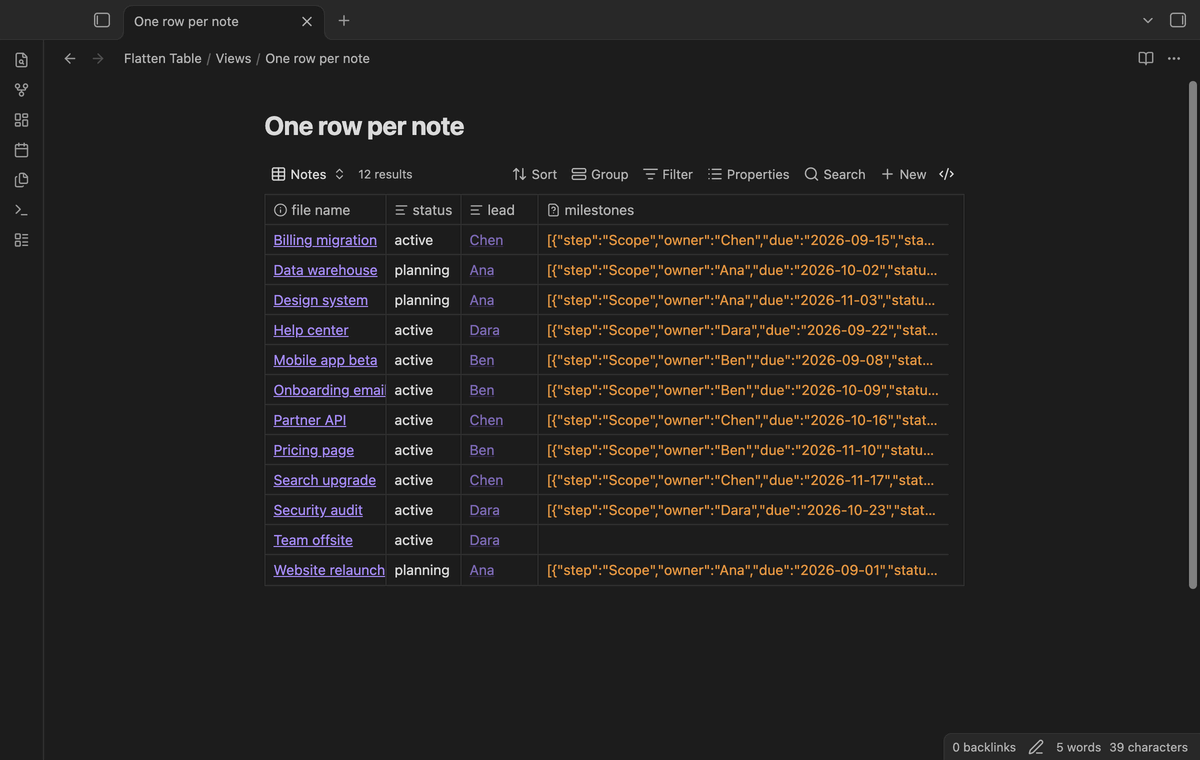
Click a column header to sort the rows, again to sort the other way, and a third time for the base order. Numbers sort as numbers, and dates in the form YYYY-MM-DD sort in date order. The sort is saved with the view in the base file.
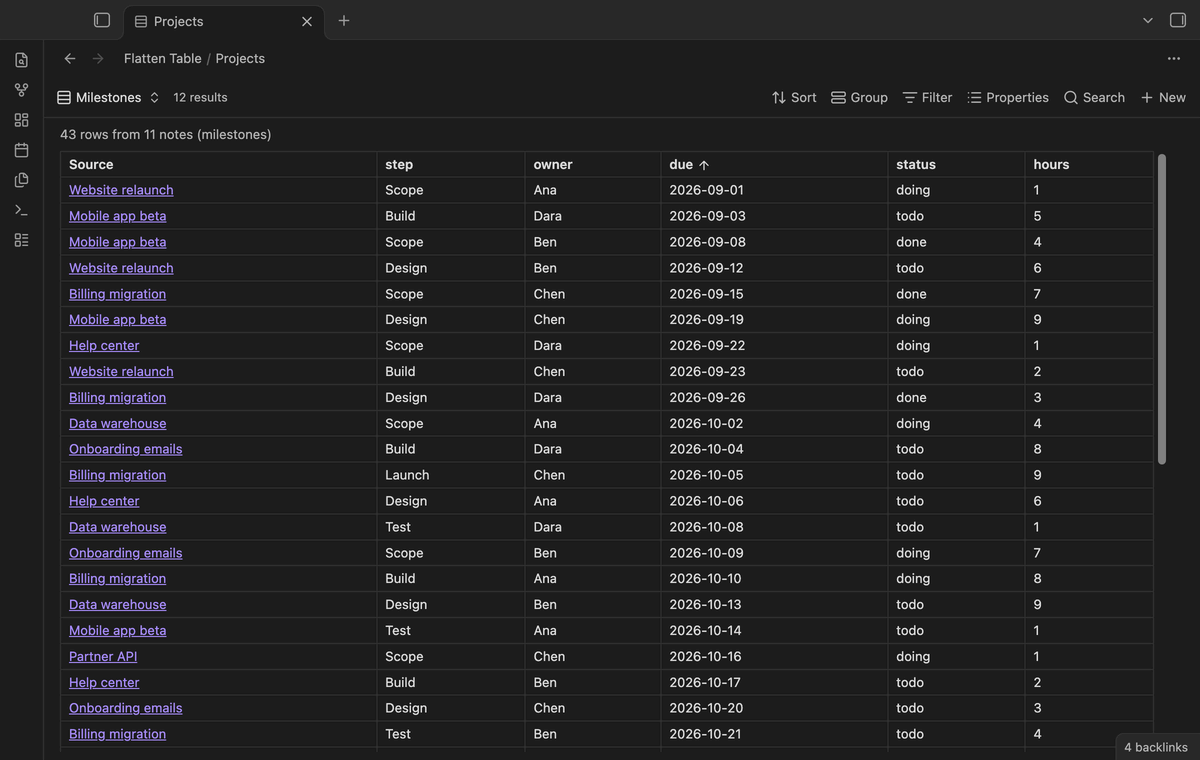
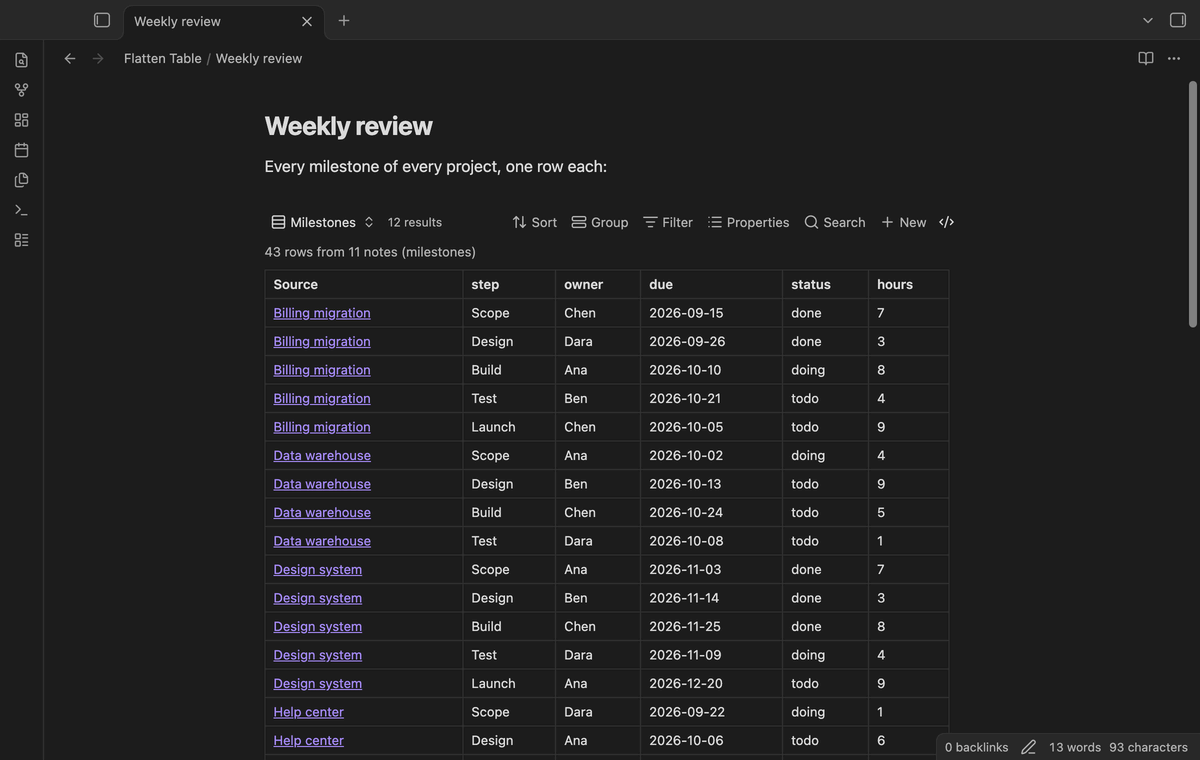
When you change a property, the table draws again after a short delay. You can embed the view in any note, for example in a weekly review.
The free version flattens the lists of up to 50 notes that have items, and the table says how many it left out.
Pro costs $5 a month or $15 one time through GitHub Sponsors. One sponsorship turns on Pro in all 13 plugins.
The free version flattens the lists of up to 50 notes that have items. Pro removes that limit.
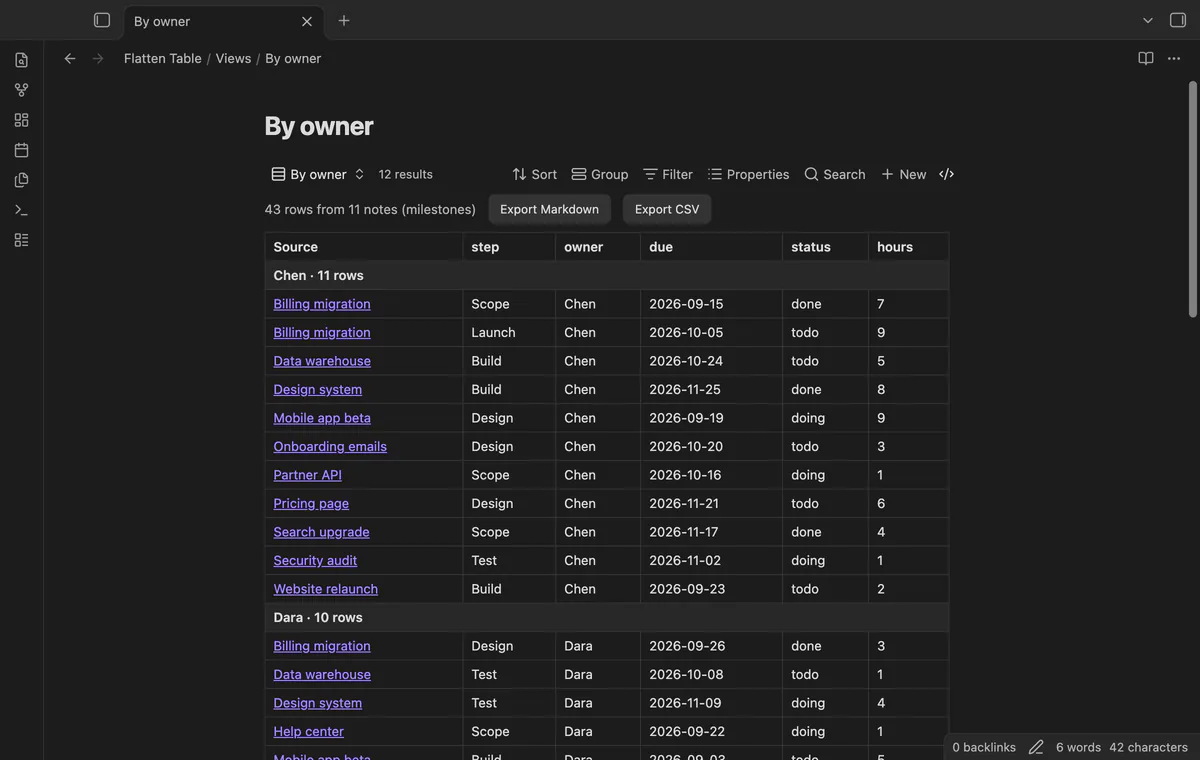
Group the rows by any column, or by Source. Each group has a header with its value and the number of rows.
The filters of the base select notes, and the row filter selects items. Keep only the rows where a column contains, equals or doesn't equal a value, or is empty. For numbers and dates, keep the rows that are larger or smaller than a value.
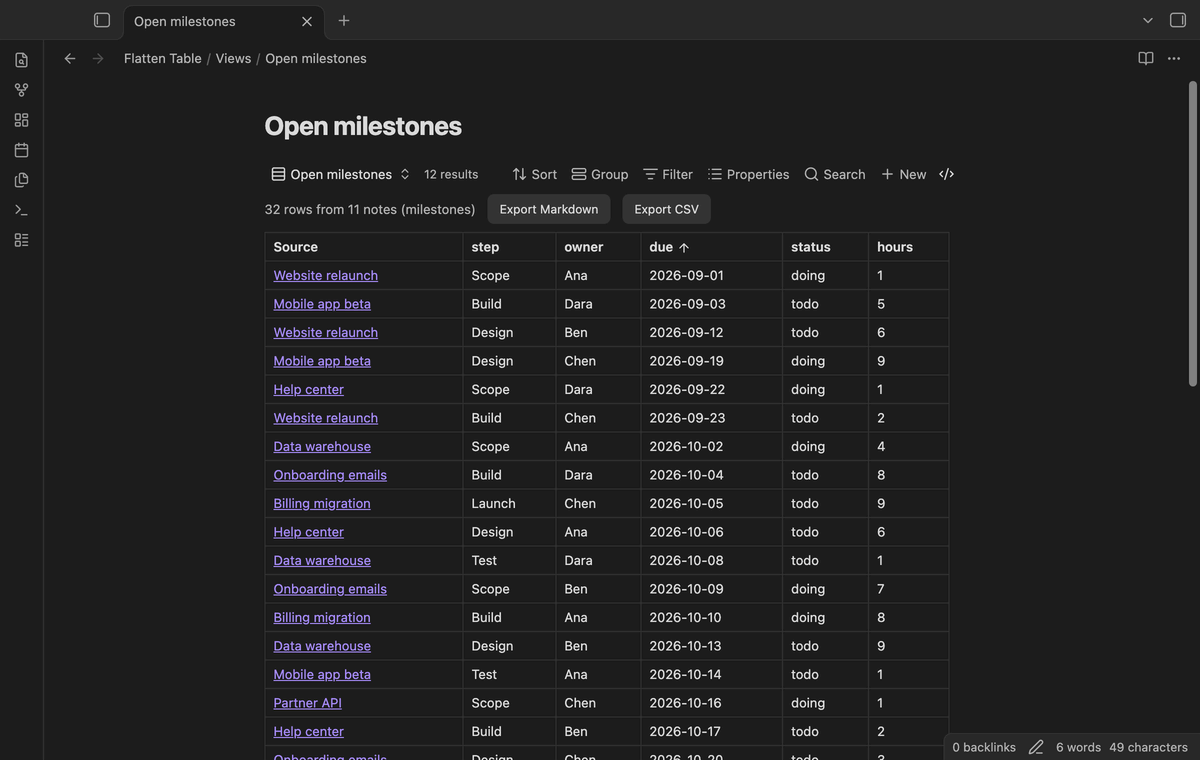
Export the flat table, with its filter and sort, to a new Markdown note or a CSV file. The Markdown table links each row back to its source note.
needs
steps
Write a list of objects in the properties of your notes. Use the source mode, because the Properties panel can't edit such a list.
Create a base, or open one, and set its filters so that it selects these notes.
Select the view menu in the base toolbar and add a view of the type Flatten table.
Open the view options. In List property, pick your list property.
Forum topic 105425 asks for a Dataview FLATTEN solution in Bases, and it has 8 votes. Without one, the only way out is a stub note for each item.
The core table view gives one row per note, so a list property is one cell. Flatten Table adds a view that gives each item of the list its own row. In the README example, 11 project notes give 43 rows.
No. It only reads the properties of your notes. Export creates a new file and doesn't touch the sources.
Dataview has FLATTEN in its query language, and it doesn't need Bases. Flatten Table works inside Bases. You get the base filters, the view menu and embeds, and you write no query.
In the end-to-end test with 500 notes and 2,500 rows, a full draw took 12 to 61 ms on an M3 Pro Mac. It reads the properties from the metadata cache of Obsidian, so it opens no file.
Flatten Table makes no network requests until you select Sign in with GitHub in the settings. From then on, it asks the GitHub API about your sponsorship at most once every 7 days, or when you select Refresh. It sends no note content, file names or other vault data.
Flatten Table 1.0.0, MIT license
MIT · no telemetry · core features free
All the rows from the small tables in your notes, in one sortable table that links back to each note.
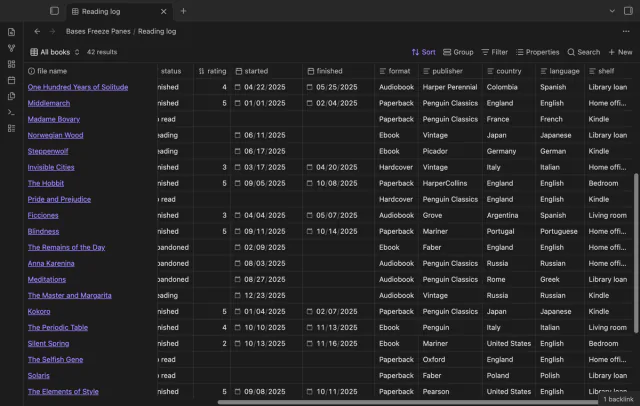
Scroll a wide base and the column names and note names stay put, like Freeze Panes in a spreadsheet.
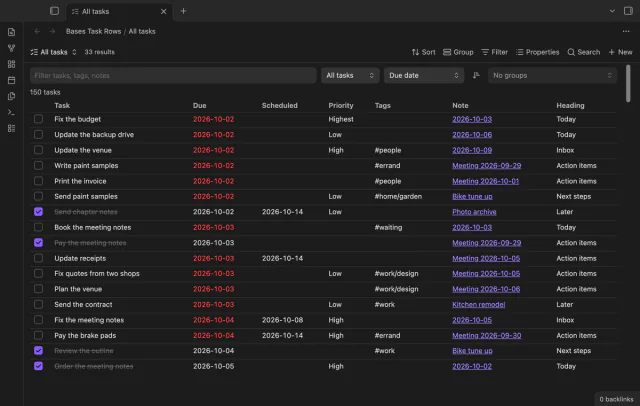
Every checklist task in the notes a base selects, one row each, with a done box you can tick.